
Full-frame viewer · Mid+
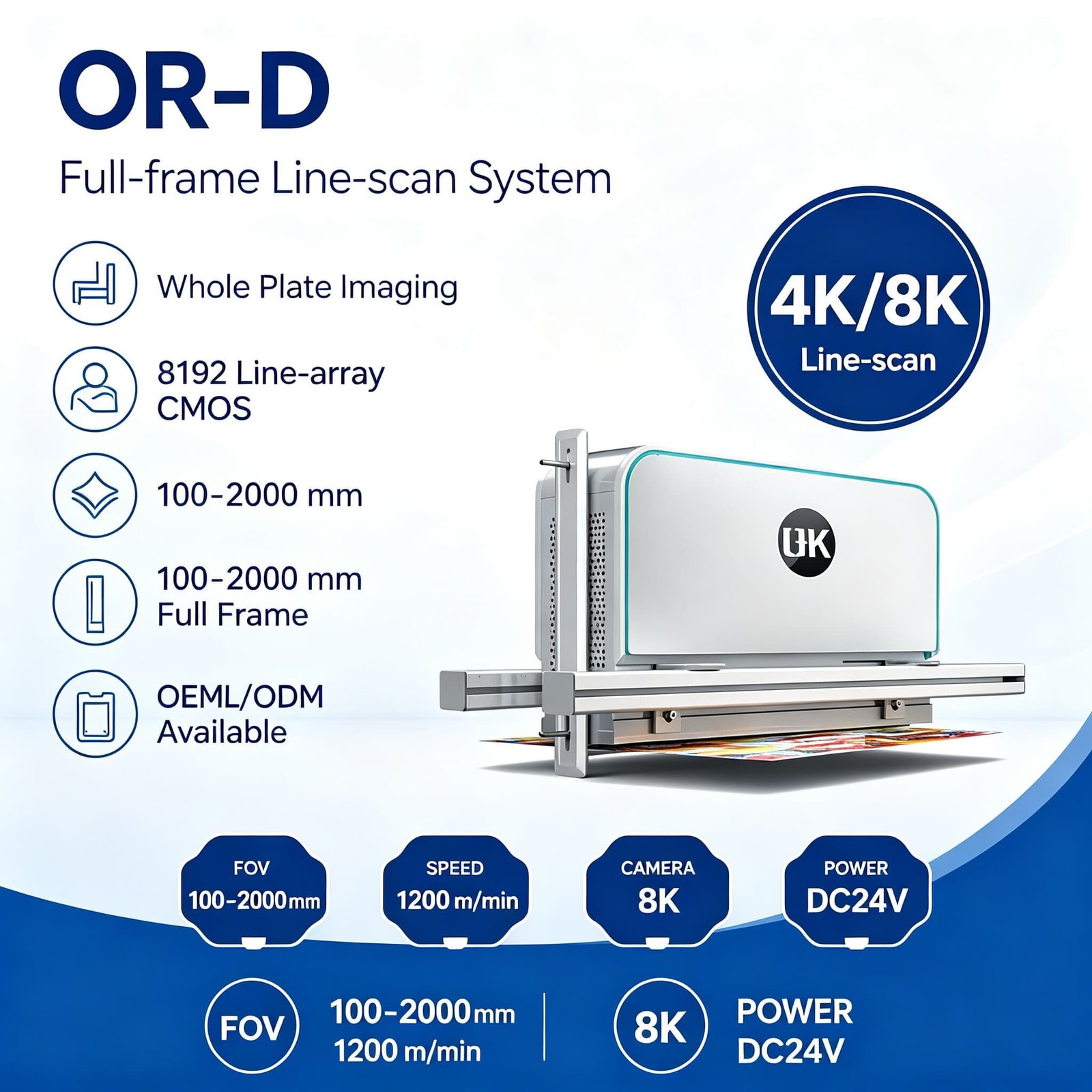
A fixed-gantry line-scan viewer that images the whole plate circumference in one frame — 100–2000 mm web width at up to 1,200 m/min.
01
What it is
A fixed gantry carries an 8K line-scan camera across the full web. One image holds the entire plate circumference, so register, missing print and a streak are judged together.
Nothing moves during a check — no rail, nothing to park or patrol.
One sensor spans 100–2000 mm; a small feature takes a small part of the frame.
Zoom magnifies the captured frame; it does not resample the web.
OR-D shows the repeat. It does not alarm, reject or log every repeat — that is a different route, linked at the end.
02
Fit
OR-D answers one question: what does the whole repeat look like in one frame. If the job needs a patrol, or an automatic judgement, another route does that.
Fits when
Does not fit when
8192 pixels across the web, 25X after the capture. Nothing moves during a check.
The same 8192 elements cover 2,000 mm, so a small feature takes a small part of the frame.
Gantry and working distance are engineered to your line, not taken from a catalogue.
03
Specifications
Published figures are reference values. Your width, rate and defect readability are confirmed with your press and a sample.
| Parameter | Published figure | What changes it |
|---|---|---|
| Sensor | CMOS line-scan, 7 µm pixel | 3-line or 6-line colour build |
| Resolution | 8192×3 / 8192×6 | Colour judgement across the repeat |
| Max line frequency | 337 kHz (×3) / 320 kHz (×6), 10-bit | Sampling pitch and web speed |
| Dynamic range | 65 dB | Lighting and exposure |
| Exposure | 3 µs–40 ms | Speed and light budget |
| Colour / mirror | Colour; horizontal mirror supported | Print orientation on the line |
| Line-frequency control | Free run / software period / encoder / external pulse | Who owns timing accuracy |
| Field of view | 100–2000 mm, full frame | Web width you commit to |
| Zoom | 25X post-processing | Frame size you capture |
| Supply / weight | DC24V; camera 456 g | Local supply and mount |
The trade-off
Design rules for a full-frame capture
Imaging span ÷ 8192 elements: 2,000 mm samples at about 0.24 mm; at 500 mm the same camera is four times finer.
Fix it at today’s widest print. Over-spanning puts half the sensor on open air.
25X magnifies the captured frame; it does not resample the web. Sub-floor marks shimmer.
1,200 m/min at 0.24 mm is roughly 83 kHz — tighten the pitch fourfold and the demand climbs with it.
The gantry is static: confirm the web plane is parallel before the cameras are set, or one side stays soft.
The trigger advances one element per step of web. A wrong roll diameter stretches every repeat.
04
Coverage
The camera is synced by encoder or external pulse and builds a full-frame image at up to 1,200 m/min. Judgement stays with the operator.
A register step at the end of the repeat is seen against its start, in one image.
Gaps inside the repeat are judged against the approved sheet.
One frame holds the full width, so a band is continuous or local in a single look.
8K plus 25X post-zoom; whether your smallest text resolves depends on line speed.
What we ask you to send, so each row means something
05
Configuration
A full-frame viewer prices as a project. These three lists settle what is in the quotation before it is written.
8K line-scan camera · controller and software · cables · encoder if required
Display · freight and duty · installation travel · taxes
Stable DC24V supply · mounting gantry and space · press drawing and a sample
Three scope levels
You mount it on an existing gantry.
StandardHigher sync, or a substrate the base light cannot serve.
Project-dependentMulti-press or multi-line projects.
Project-dependentMaterials it runs — and what the full frame exposes
What drives the cost
Gantry, mounting and — near 2 m — the lighting all scale with the width you commit to.
8192×3 and 8192×6 are different instruments; the six-line build earns its place only when colour judgement matters.
Encoder or an external pulse from the press decides who owns timing accuracy.
Controller, software and the number of screens in the scope.
06
Line and installation
The gantry is fixed across the web. Web width, plate repeat and working distance are confirmed before quoting; the controller sits at the operator station.
In the set
You confirm
Four steps to a working reference
Span set to the width you actually run, not the catalogue maximum.
Encoder or press pulse; one element per step of web.
Angle and exposure fixed at commissioning and written down.
One full-frame grab of an approved print, per job.
07
Limits
Four limits, said plainly, because they decide the route.
No automatic alarm, marking, stop or reject; the OK series does that.
It shows the repeat; it does not log every repeat.
No traverse and no saved-point patrol; Overseer is the patrol route.
Confirm before quoting, and prove clear film or metallic ink on a sample.
08
Evidence
Reference images show the reference machine. They do not prove visibility on your print — a sample test does.
Shows the 8K sensor and full-frame parameters. Does not show your final configuration.
Shows camera, gantry and software arrangement. Does not show your tooling or options.
Shows whether a defect is visible on your print. It is not a guarantee of 100% detection.
Acceptance test — what we run
Symptom → likely cause → what to check
| What the single frame shows | Where it belongs | What to check |
|---|---|---|
| Repeat aligns at the frame start but steps at the frame end | Print unit registration | Plate circumference entered vs encoder ratio |
| A streak running the whole web | Coating head or doctor blade | Whether it sits at a fixed lane every repeat |
| One vertical line of missing data | Scan triggering | Trigger jitter and cable integrity at capture |
| Pinhole only on clear stock | Optical signature | Backlight geometry and exposure |
| Every repeat slightly squeezed | Web-to-pixel relationship | Encoder mounting or wrong roll diameter |
| One side soft, one side sharp | Focus across the span | Camera alignment, then web plane vs gantry |
| Banding across the full frame | Lighting or capture | Strobe sync, then line rate against exposure |
09
Delivery
Four things are confirmed with the order, in writing. Start with a sample if you want to see the frame before deciding.
7–45 days on the confirmed configuration. We give the date with the order, and we tell you if the span or lighting moves it.
We pack for export and quote express or sea freight against your address; duty and taxes are on the buyer’s side.
2-year machine warranty for non-human damage, lifetime technical support. Spare parts are a separate item — we send the list with the machine.
Remote guidance as standard. If you want an engineer on site we arrange it; travel, accommodation and the service fee sit on the buyer’s side.
Sample first, then decide. Send a print with the smallest text and one known defect — we run it and send the frame before any commitment.
10
A fixed-gantry, 8K line-scan full-frame viewer.
100–2000 mm full frame.
1,200 m/min published.
8192×3 / 8192×6, 7 µm, 65 dB, 10-bit.
No; it is a viewer. The OK series does automatic inspection.
No; it is fixed. Overseer is the saved-position patrol route.
Confirm the scope; a local monitor is typically supplied by the buyer.
4K has no official page; confirm before quoting.
8K plus 25X zoom; confirm the text size on a sample.
It needs a sync source: encoder or external pulse. Confirm the press interface.
It images the full frame while the web runs; there is no traverse.
Yes, if the gantry and web path allow; send a layout drawing.
Confirm the lighting scope for your material; clear film and metallic ink need a sample test.
It is a single-side viewer; a second camera or backlight is a separate configuration.
OR-D is a fixed full-frame viewer; Overseer adds saved-position patrol, AutoScan and dual-camera options.
The gantry is project-specific; confirm the scope and mounting with the order.
Yes; confirm web width, lighting and the inspection position.
The controller and software run the system; confirm the display and network route.
2-year machine warranty for non-human damage plus lifetime technical support; spare parts are a separate commercial item.
Confirmed with the configuration; standard builds are quoted at 7–45 days depending on the scope.
11
Routes
OR-D is the full-frame route. If the job is narrower, needs patrol, or needs a decision rather than a view, the route is here.
| If the job is | Route | What you get |
|---|---|---|
| See the whole repeat in one frame | This page — OR-D | One image across 100–2000 mm |
| Judge the print across the web | Web monitoring — Observer, OR-B/C, Overseer | A frozen, zoomed window |
| Watch one mark or crosshair | Print mark — Scout 3 / OR-A | One fixed or manually moved point |
| Judge and record every repeat | 100% inspection — OK-4000 / OK-6000 | Defect map, record per roll, 24V signal |
Before you ask for a quote
Next step
A photo of the print and the smallest defect you must catch is enough to confirm the model, the resolution and the lighting.
Send your product, material and target output. We reply with a configuration and an itemised quotation.
