
Web monitoring · entry+ to mid
Freeze the moving web and judge the print at running speed. Five builds across four window sizes: manual rail, motorized traverse, or saved-position patrol. A viewer, not an inspection system.
01
What it is
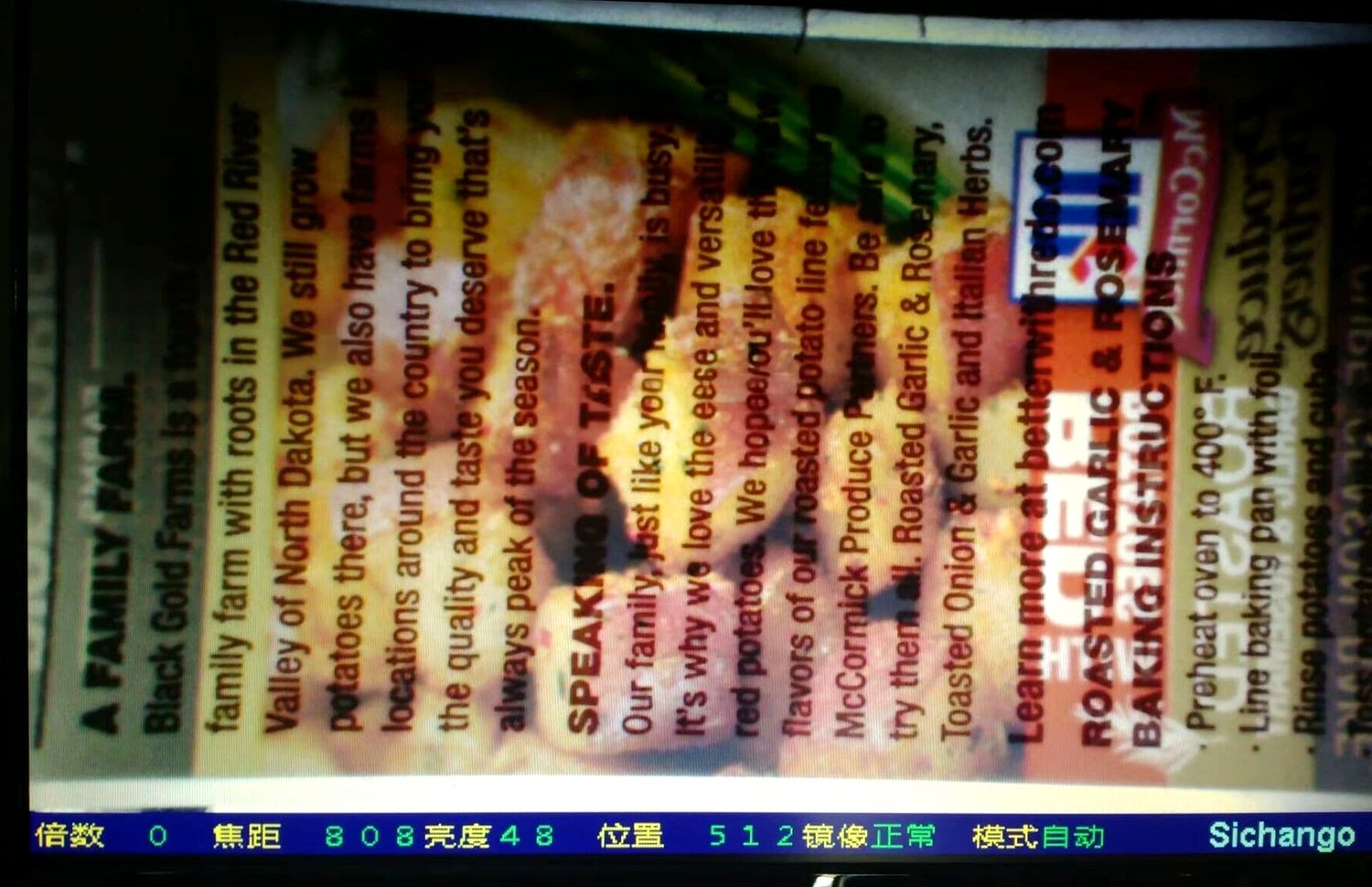
A camera over the web freezes the moving print onto a screen. The operator judges registration, ink and small text without slowing the press or pulling a sheet.
The frame is held, so a moving defect can be read at running speed.
Optical zoom on Observer, digital to 25X on OR-B/C, 10–20X on Overseer.
Keyboard at the controller, or a touchscreen at the machine.
Five builds sit in this family. The question is not which is newest: it is how much web you must reach, how large a window you need, and whether the operator returns to the same points every shift.
02
How it moves
Same camera idea, three ways of getting it to the print. This is the first decision, before window size.
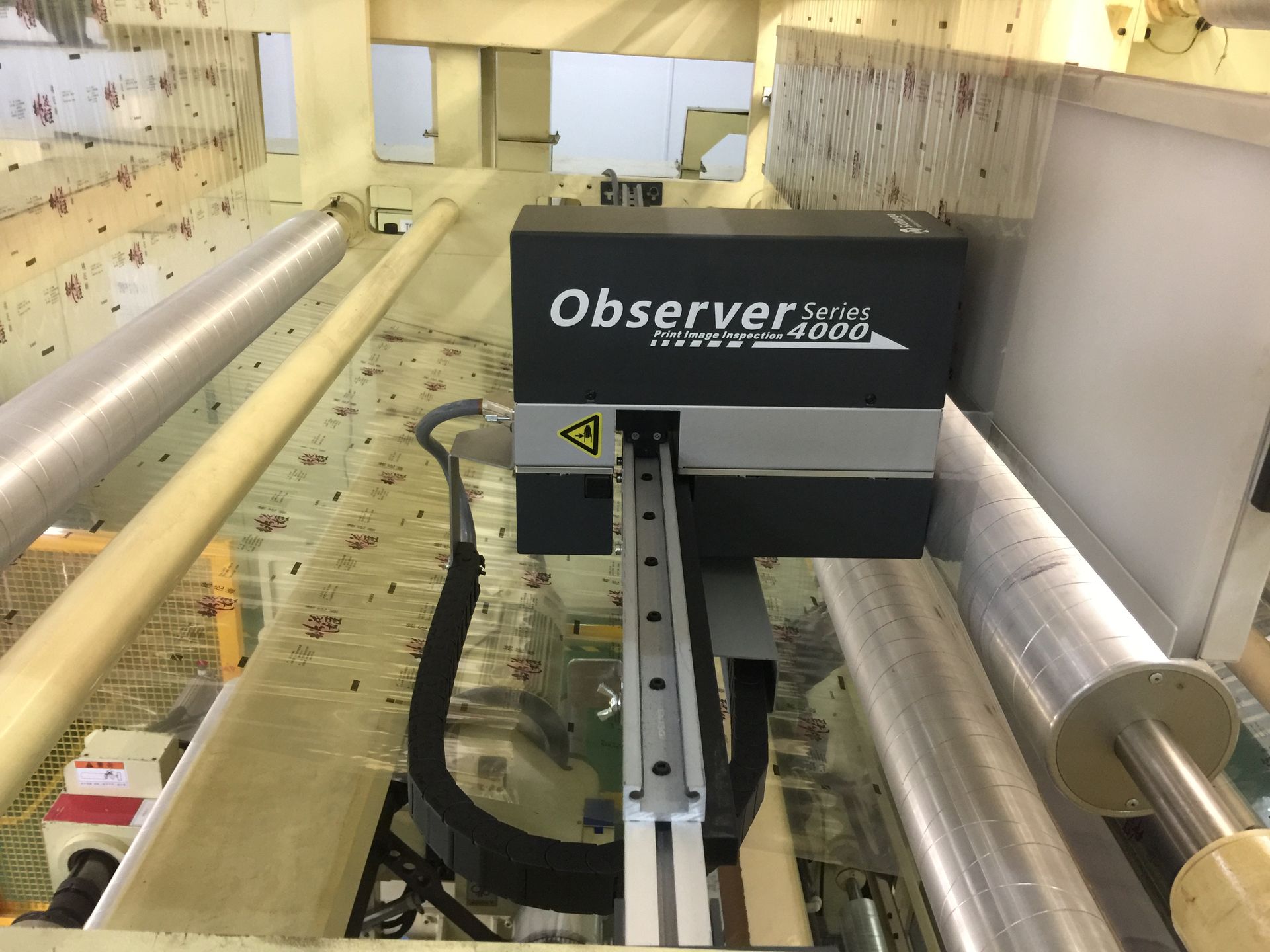
The operator walks the head along the rail to the point being judged. Simplest build, nothing to motorise.
Entry+Rail up to 3 m, head driven from the controller. The operator stays at the screen while the camera moves.
Entry+Ten positions in five recipes. The head returns to each saved point on its own; dual speed 50 / 150 mm/s.
MidOR-B and OR-C sit beside the manual rail
03
Compare
Window size and pixel count decide what the operator can actually judge. Figures are published values; your print decides the rest.
| Build | Window | Camera / zoom | Movement | Best for |
|---|---|---|---|---|
| Observer 4000R | 100 × 75 mm | 2 MP, 30X optical | Manual rail | One web, operator walks the rail |
| Observer 4000M | 100 × 75 mm | 2 MP, 30X optical | Motorized, up to 3 m | Wide web, operator stays at the screen |
| OR-B | 100 × 75 mm | 5 MP, 25X digital | Manual rail, 300–3000 mm | Flexo, more pixels in the same window |
| OR-C | 200 × 150 mm | 5 MP, 25X digital | End-to-end cruise | Gravure, a wider window per look |
| Overseer 100 | 100 × 75 mm | 2 MP, 10X | Saved positions, 10 / 5 recipes | The same points every shift |
| Overseer 200 | 200 × 120 mm | 14.4 MP, 20X | Saved positions, 10 / 5 recipes | Wide web patrol with a large window |
Also on Overseer
04
Specifications
OR-B and OR-C share one body and one control box; their figures are in the comparison above.
| Parameter | Observer 4000R / 4000M | Overseer 100 | Overseer 200 |
|---|---|---|---|
| Camera | 2 MP CMOS, 1280 × 1024 | 2 MP, 1600 × 900 | 14.4 MP, 1920 × 1080 |
| Field of view | 100 × 75 mm | 100 × 75 mm | 200 × 120 mm |
| Magnification | 30X optical, 1–64X digital | 10X | 20X |
| Capture | 10 images/sec | Dual-speed traverse 50 / 150 mm/s | Dual-speed traverse 50 / 150 mm/s |
| Line speed | Above 400 m/min | 400 m/min | 400 m/min |
| Web width | Rail made to order, up to 3 m | 0.5–6 m | 0.5–6 m |
| Working distance | Best 8–12 mm | Best 8–12 mm | Best 8–12 mm |
| Supply | 110–240 V | Confirm per order | Confirm per order |
| Display | Not included — 24″ HDMI, local | Optional 24″ touchscreen | Optional 24″ touchscreen |
05
Coverage
A viewer answers one question: can this be seen clearly at speed. The judgement stays with the operator.
Split-screen against a reference; drift read lane by lane.
Zoom to the smallest mark the window can resolve.
Zoom on the code and read it on screen.
CMYK check on Overseer; a visual comparison elsewhere.
06
Machine in operation
Five short films, one per build: how the head moves, what the operator sees, and where each one is used.



07
Limits
Four limits, said plainly, because they decide whether this is the right family at all.
It shows the print. Comparing every repeat, alarming and rejecting is the OK series.
A still image is not a per-roll log or a customer report.
The head sees 100 × 75 mm, or 200 × 150 mm on OR-C — not the full width.
Metallic ink, deep emboss and low-contrast stock are confirmed on your print, not a datasheet.
08
Line and installation
The head mounts on the press frame or a stand over the web. Nothing needs the internet.
In the set
You supply
Four steps to a working view
Manual, motorized or saved positions — from how the operator works.
Working distance 8–12 mm, light set on your stock.
Gear sensor standard; encoder where the press needs one.
Zoom, brightness and positions stored per job.
09
Delivery
Four things are confirmed with the order, in writing.
7–45 days on the confirmed configuration; the rail length is the usual variable.
Export packing; express or sea freight quoted to your address; duty and taxes on the buyer’s side.
2-year machine warranty for non-human damage, lifetime technical support; spare parts priced separately.
Remote guidance as standard; an engineer can be arranged, with travel, accommodation and service fee on the buyer’s side.
10
Questions
The questions that pick a build.
If the operator walks the rail, 4000R. If the operator should stay at the screen, 4000M. If the same positions are checked every shift, Overseer patrols them for you.
Same 100 × 75 mm window. Observer uses a 2 MP camera with 30X optical zoom; OR-B uses 5 MP with 25X digital zoom on a manual rail.
When one lane is not enough: its window is 200 × 150 mm, so a wider area is judged in one look on gravure.
No. A viewer sees one window. For the whole repeat in one frame, OR-D; for every repeat judged automatically, the OK series.
It shows the print; it does not keep a per-roll record or produce a customer report.
Send a print. Contrast decides whether the defect shows, and that is judged on your material, not on a specification.
Observer and OR-B/C: a 24-inch HDMI monitor, bought locally. Overseer: 24-inch touchscreen is an option.
2-year machine warranty for non-human damage with lifetime technical support; standard builds are quoted at 7–45 days.
11
Routes
If the job changes — wider, automatic, or one fixed mark — the route is here.
| If the job is | Route | What you get |
|---|---|---|
| Judge the print across the web | This page — 4000R / 4000M / OR-B / OR-C / Overseer | A frozen, zoomed window |
| Watch one mark or crosshair | Print mark — Scout 3 / OR-A | One fixed or manually moved point |
| See the whole repeat in one frame | Full-frame — OR-D | One image across 100–2000 mm |
| Judge and record every repeat | 100% inspection — OK-4000 / OK-6000 | Defect map, record per roll, 24V signal |
Next step
A photo of the print and the smallest defect you must catch is enough to confirm the model, the resolution and the lighting.
Send your product, material and target output. We reply with a configuration and an itemised quotation.
